Golden Bay History
Golden Bay is known in Maori as Mohua. Its history spans early Polynesian settlement, tribal migrations, and the first recorded contact between Maori and Europeans in New Zealand
Maori History
Maori lived along the shores of Mohua from at least 1450, which is the earliest dated archaeological evidence (from carbon dating) yet found. They established sites along the coast, ranging from kainga (traditional village) to pa (fortified villages or settlements) and probable kumara gardens
In earlier times this area witnessed waves of Maori invasion and settlement long before the arrival of European immigrants. Ngati Tumata Kokiri were thought to have been here since the early 1600s before being displaced by Ngati Apa.
In 1828 the migration of North Island iwi to the South Island took place.
The Taranaki wars of the 1860s and 1880s and Parihaka resistance caused a significant exodus of Maori from the Bay, but some manawhenua chose to remain.
In 1992, the Onetahua Kokiri Marae was formally established in the old school at the top of the Pohara Valley.
Today, the iwi of Golden Bay are Manawhenua ki Mohua Ngati Tama, Ngati Rarua and Te Atiawa.
European History
When Dutch explorer Abel Janszoon Tasman sailed into New Zealand waters and came upon this ”large and highly elevated land”, he was looking for a great southern continent.
For centuries many had imagined such a land mass in the southern ocean between Australia and South America. The voyage was organised by the Dutch East India Company, looking for opportunities to expand its wealth.
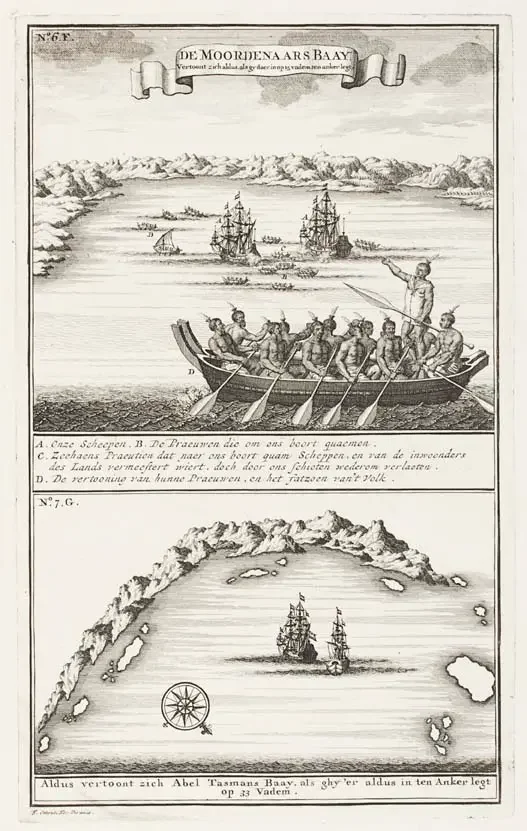
On 13 December 1642, Tasman and his crew on the Heemskerck and Zeehaen made the first recorded sighting of New Zealand as they sailed towards the South Island’s West Coast, Te Tai Poutini. Adding New Zealand to the world map had begun.
A few days later they rounded Farewell Spit and anchored on December 17th in Mohua (what is now Golden Bay), making the first known contact with Maori.
Mutual cultural misunderstanding is thought to have led to a brief but violent confrontation, and there was loss of life on both sides. Tasman quickly sailed away, waited out a storm in the lee of Rangitoto/D’Urville island, before sailing up the west coast of the North Island. After another sighting of Maori, on the Three Kings Islands, they left New Zealand waters on 6 January 1643. Tasman named Golden Bay Moordenaarsbaai, meaning Killers or Murderers Bay.
Tasman’s voyage is a landmark milestone in European New Zealand history. There is no earlier written record; no earlier meeting documented. Words and images capture the two worlds at a moment in time, marking the start of New Zealand’s shared history.
In 1840 The New Zealand Company arrived at Whakatu and renamed it Nelson.
Golden Bay was considered too remote for Europeans but permanent settlement began in 1854-55 with pioneers disembarking at Waitapu and Collingwood. The discovery of gold and industrial enterprise in coal, timber, flax and dairy products fueled the development and the renaming to Golden Bay. Today the primary industry remains dairy farming.